
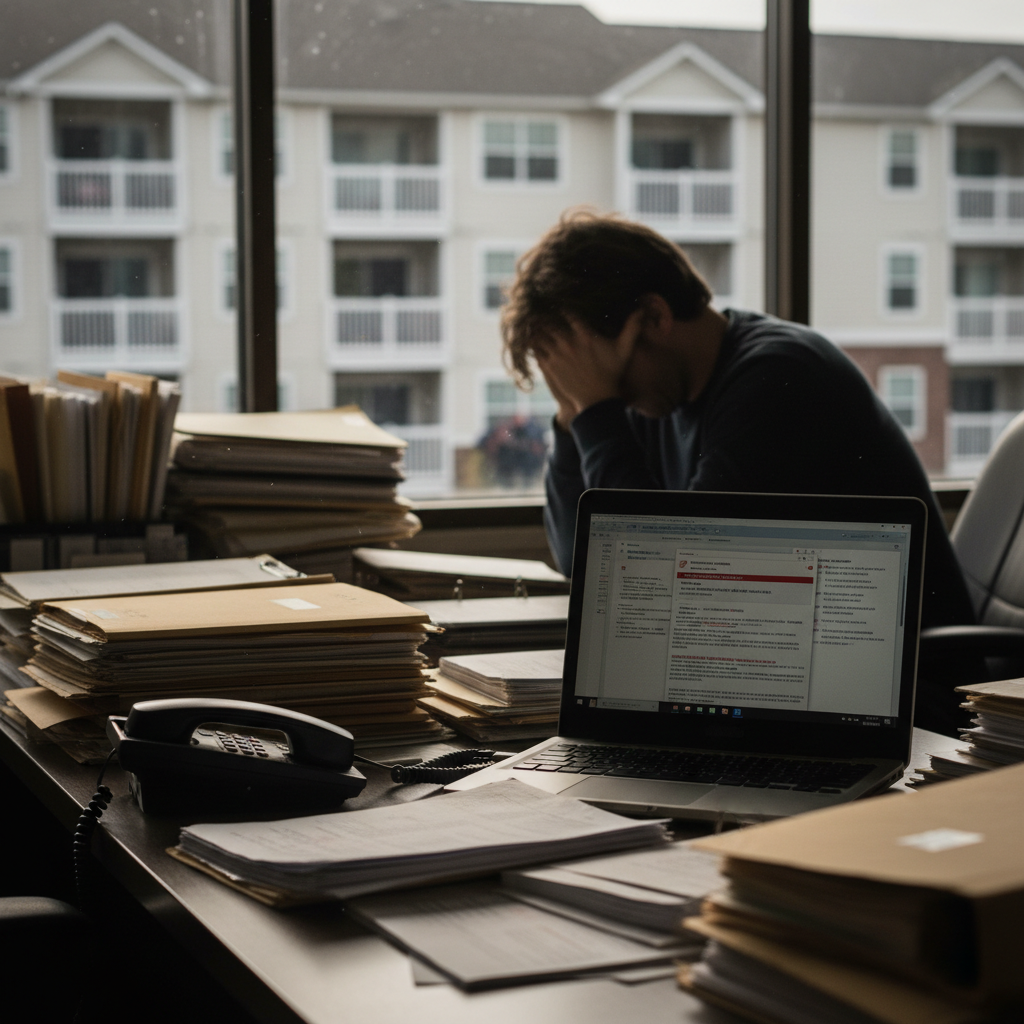
We're in March 2026, and the property management industry continues to grapple with a pervasive issue: burnout. For too long, the narrative has centered on individual resilience, on 'mindset shifts,' or on 'better time management' as the panacea for overwhelmed property managers. I'm here to tell you, unequivocally, that this perspective is fundamentally flawed. Burnout in property management is not a personal failing, it is a systemic staffing problem, exacerbated by unrealistic expectations and an outdated operational model.
Let's be clear about the economics here. Property management, at its core, is a service business. Our revenue is directly tied to the number of doors we manage, and our profitability hinges on the efficiency with which we manage them. When we see property managers working 60-hour weeks, juggling 100-plus units, handling everything from leasing inquiries to emergency maintenance, it's not because they lack grit. It's because the staffing ratios are broken. The workload has simply outpaced the human capacity allocated to it.
Consider the typical property manager's day. They are expected to be a leasing agent, a maintenance coordinator, a financial analyst, a legal expert, a customer service representative, and occasionally, a therapist. This isn't a job description, it's a list of five different jobs. And yet, we often expect one person to excel at all of them, armed with little more than a property management software suite, perhaps AppFolio or Yardi, and a strong cup of coffee. The industry has been slow to adapt to the increasing complexity of tenant demands and regulatory environments, while simultaneously pushing for leaner operational budgets.
The data, if you bother to look, supports this. High turnover rates are endemic. I've seen countless discussions on forums like Reddit r/PropertyManagement where the core complaint isn't about the difficulty of the tasks themselves, but the sheer volume and the lack of support. People leave not because they dislike property management, but because the job is unsustainable. This constant churn creates a vicious cycle: experienced staff leave, new staff are brought in and quickly overwhelmed, and the remaining team members pick up the slack, leading to more burnout and more departures. It's an expensive treadmill, both in direct recruitment costs and in lost productivity and institutional knowledge.
The solution, in my view, lies in a strategic re-evaluation of how we staff our operations. This isn't just about hiring more bodies, although that's often a necessary first step. It's about disaggregating the property manager role. What tasks truly require a local, on-site presence? What can be centralized? What can be automated? And, critically, what can be effectively handled by remote talent?
Take the administrative burden, for instance. Lease renewals, application processing, vendor invoice entry, even initial tenant screenings. These are critical functions, but they don't necessarily require someone physically present in the office or on the property. Remote teams, often with specialized skills, can handle these tasks with greater efficiency and often at a lower cost, freeing up on-site property managers to focus on the high-value activities that truly require their local expertise: property inspections, tenant relations, and strategic asset management. This isn't a radical idea; other industries have been doing this for decades. The real estate sector, however, has a peculiar attachment to traditional models, sometimes to its own detriment.
Furthermore, the rise of AI and automation is not a threat to property management jobs, but an opportunity to redefine them. Tools from companies like OpenAI or Google AI are rapidly evolving, offering solutions for everything from answering common tenant questions to triaging maintenance requests. When integrated thoughtfully, these technologies can offload a significant portion of the repetitive, high-volume tasks that contribute to burnout. This allows human property managers to focus on complex problem-solving, relationship building, and strategic decision-making, which are the aspects of the job that are both more fulfilling and more impactful.
The shift requires a leadership perspective that understands the long-term cost of burnout far outweighs the short-term savings of understaffing. It means investing in robust training, clear process documentation, and a culture that supports work-life balance not as a perk, but as a fundamental operational requirement. Organizations like NARPM and IREM are doing valuable work in professional development, but even the best-trained individual cannot overcome an insurmountable workload.
My advice to property management executives is this: stop looking for a magic pill to fix your team's 'attitude.' Instead, audit your workflows. Quantify the time spent on each task. Identify bottlenecks. Then, strategically deploy technology and remote talent to alleviate the pressure points. This isn't just about being a 'better' employer; it's about building a sustainable, scalable business model for the future. The industry is evolving, and those who fail to adapt their staffing strategies will find themselves not only losing their best people but also falling behind in a competitive market. The future of property management isn't about working harder; it's about working smarter, with the right people, in the right roles, supported by the right technology.