

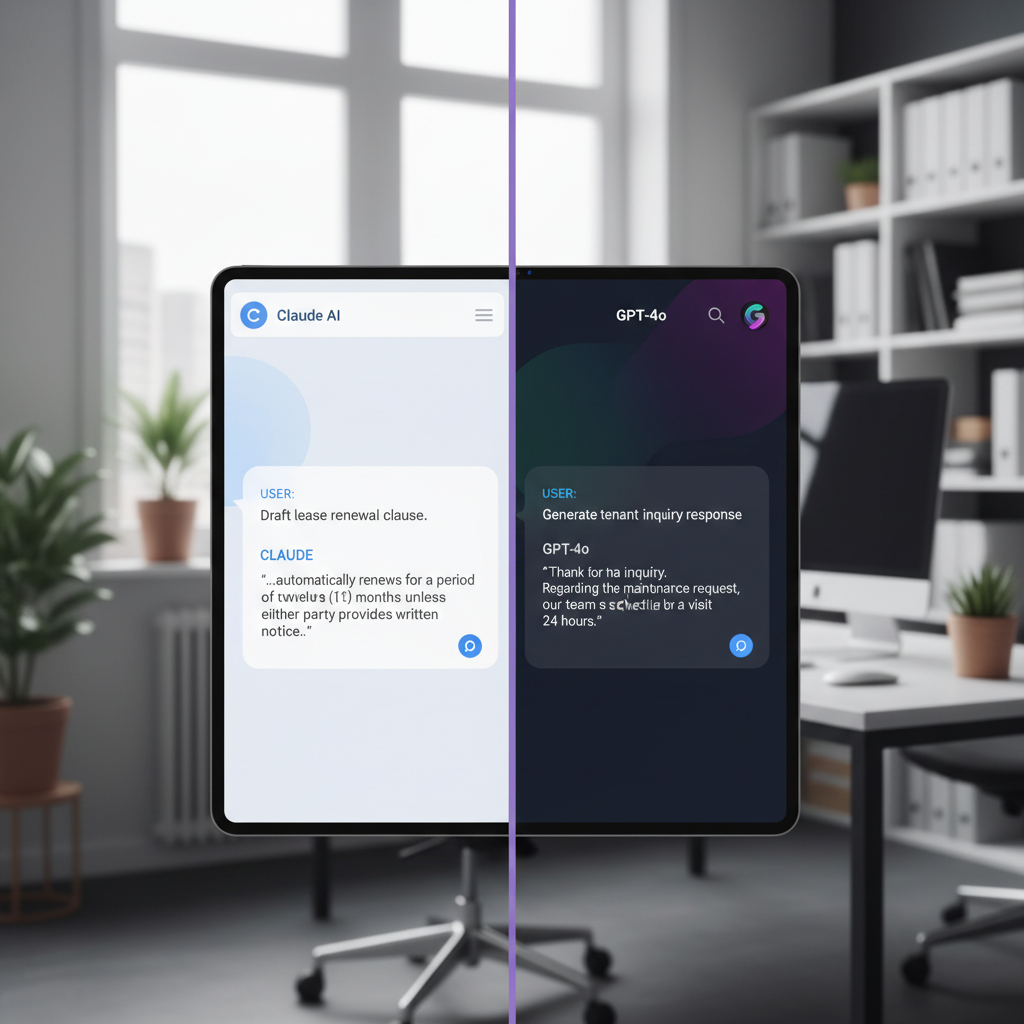
Alright, folks, let's talk about the AI elephant in the room, or rather, the two AI elephants. We're past the 'what is AI' stage; now it's about 'which AI for what task.' Specifically, for us in property management, the big contenders right now are Anthropic's Claude and OpenAI's GPT-4o. I've been running both through the wringer, testing them on everything from lease amendment drafts to tenant communication, and I'm ready to spill the beans.
First, a quick primer. OpenAI has been the household name for a while, and GPT-4o is their latest multimodal marvel. Think of it as a Swiss Army knife, good at many things, and now with better voice and vision. Then there's Anthropic, with their Claude models, which often fly a bit under the radar for the general public but are absolute beasts in specific areas, especially for long-form text and complex reasoning. My team and I have been integrating these into our workflows at Property Remote Staffing, trying to figure out where each shines.
The Lease Amendment Gauntlet: Long Context is King
Let's start with a classic PM headache: lease amendments. We often get requests for minor tweaks, addendums for pet policies, or even full-blown lease renewals with new terms. The challenge isn't just drafting, it's making sure the new language integrates seamlessly with an existing, often lengthy, lease document without introducing contradictions. This is where context window becomes crucial.
Claude, particularly Claude 3 Opus, has an absolutely massive context window. I'm talking about being able to feed it an entire 50-page lease agreement, plus the tenant's request, plus our internal policy, and ask it to draft a compliant amendment. It handles this with remarkable coherence. It's like having a paralegal who's read every word of the original document and remembers it all. The output is usually solid, requiring minimal human review for consistency. It's not perfect, but it's a huge time-saver. We're talking about drafting complex clauses in minutes that used to take hours of careful cross-referencing.
GPT-4o, while improved, still struggles a bit more with truly gargantuan documents. If you feed it a 50-page lease, it might 'lose' some details from the beginning or end of the document by the time it gets to the middle. It's like it has a shorter-term memory for really long inputs. For shorter amendments, it's perfectly capable, but for those deep dives into multi-page legal docs, Claude has the edge. This is a big deal for compliance, right? You don't want an AI drafting something that contradicts page 37 of a lease because it forgot what was on page 5.
Tenant Communication: The Art of Empathy and Clarity
This is where things get interesting, and frankly, where I think GPT-4o often pulls ahead, especially for tone and nuance. Property management is a people business, and communication needs to be empathetic, clear, and sometimes, firm but fair. We're not just sending out generic notices; we're dealing with sensitive situations, rent arrears, maintenance issues, and neighbor disputes.
GPT-4o, in my testing, seems to have a more natural, conversational flow. It's better at understanding the implied sentiment in a tenant's email and crafting a response that addresses their concerns while upholding our policies. For example, if a tenant sends a somewhat agitated email about a slow maintenance response, GPT-4o can draft a reply that acknowledges their frustration, apologizes for the delay, and provides a clear next step, all while maintaining a professional, reassuring tone. It's like it has a slightly higher EQ, if you will.
Claude is good, don't get me wrong. It's excellent at being polite and clear. But sometimes, its output can feel a little too formal, a bit too 'textbook,' when you need something that feels more human. For standard notices, rent reminders, or even initial lease inquiries, Claude is perfectly fine. But for those trickier, more emotionally charged communications, GPT-4o often hits the mark better. Think about the kind of nuanced communication you see on Reddit r/PropertyManagement discussions; it's rarely just factual, there's always an underlying human element.
Data Extraction and Summarization: The Unsung Heroes
Both models are fantastic at summarizing information. Need a quick digest of a new municipal housing ordinance? Both can do it. Want to pull key dates and clauses from a stack of vendor contracts? They're both pretty good.
However, for complex data extraction from unstructured text, Claude often feels more robust. If I give it a scanned PDF of a property inspection report (after OCR, of course) and ask it to pull out all instances of 'mold,' 'leak,' or 'damaged appliance' and categorize them by severity, Claude tends to be more accurate and thorough. It's like it's better at 'parsing' the messiness of real-world documents. This is a huge win for maintenance teams trying to quickly triage issues from detailed reports. Imagine integrating this with your AppFolio or Yardi maintenance modules; the possibilities are pretty exciting.
GPT-4o is no slouch here, but I've found it occasionally misses things or makes slightly more 'creative' interpretations, especially if the document is poorly formatted or has a lot of jargon. For structured data, like a spreadsheet, both are great. But for the wild west of PDFs and emails, Claude has a slight edge in reliability.
The Multimodal Factor: GPT-4o's Ace in the Hole
This is where GPT-4o really flexes its muscles. Its multimodal capabilities are genuinely impressive and open up new workflows we're just beginning to explore. Imagine a tenant sending a photo of a broken pipe. With GPT-4o, you can feed that image directly into the model and ask it to describe the issue, suggest potential causes, and even recommend a type of vendor. Or, if you're doing a virtual walkthrough, you could potentially feed video snippets and ask for a summary of issues.
While Claude 3 Opus also has strong multimodal capabilities, GPT-4o's integration feels a bit more seamless and its real-time voice interaction is genuinely groundbreaking. For property managers who are constantly dealing with visual information, whether it's photos from inspections, videos from tenants, or even floor plans, this is a game-changer. It's not just about text anymore; it's about understanding the entire context of a problem, visually and verbally. This could significantly speed up initial maintenance triage, reducing the back-and-forth with tenants and vendors.
The Verdict: It's Not a Zero-Sum Game
So, which one wins? The honest answer, as always, is: it depends. And more importantly, it's not an either/or situation. I see these as complementary tools, each with its own sweet spot.
- Use Claude for: Long-form document analysis, complex legal drafting, thorough data extraction from messy documents, and tasks requiring deep, consistent reasoning over large bodies of text. Think lease reviews, policy drafting, and detailed report analysis. Its reliability with large context windows is a superpower.
- Use GPT-4o for: Nuanced tenant communication, quick content generation with a human touch, brainstorming creative solutions, and any task involving multimodal inputs (images, voice). Its conversational ability and multimodal prowess make it excellent for front-facing interactions and rapid problem assessment.
My advice? Don't pick a side. Integrate both. Use Claude for your backend, heavy-lifting legal and document work, and deploy GPT-4o for your front-end communication and rapid-fire, multimodal problem-solving. It's like having two different specialists on your team, each excelling in their domain. The real magic happens when you orchestrate them together, creating intelligent workflows that genuinely make a difference in your day-to-day operations. The future of PM AI isn't about one model; it's about the intelligent deployment of many.