

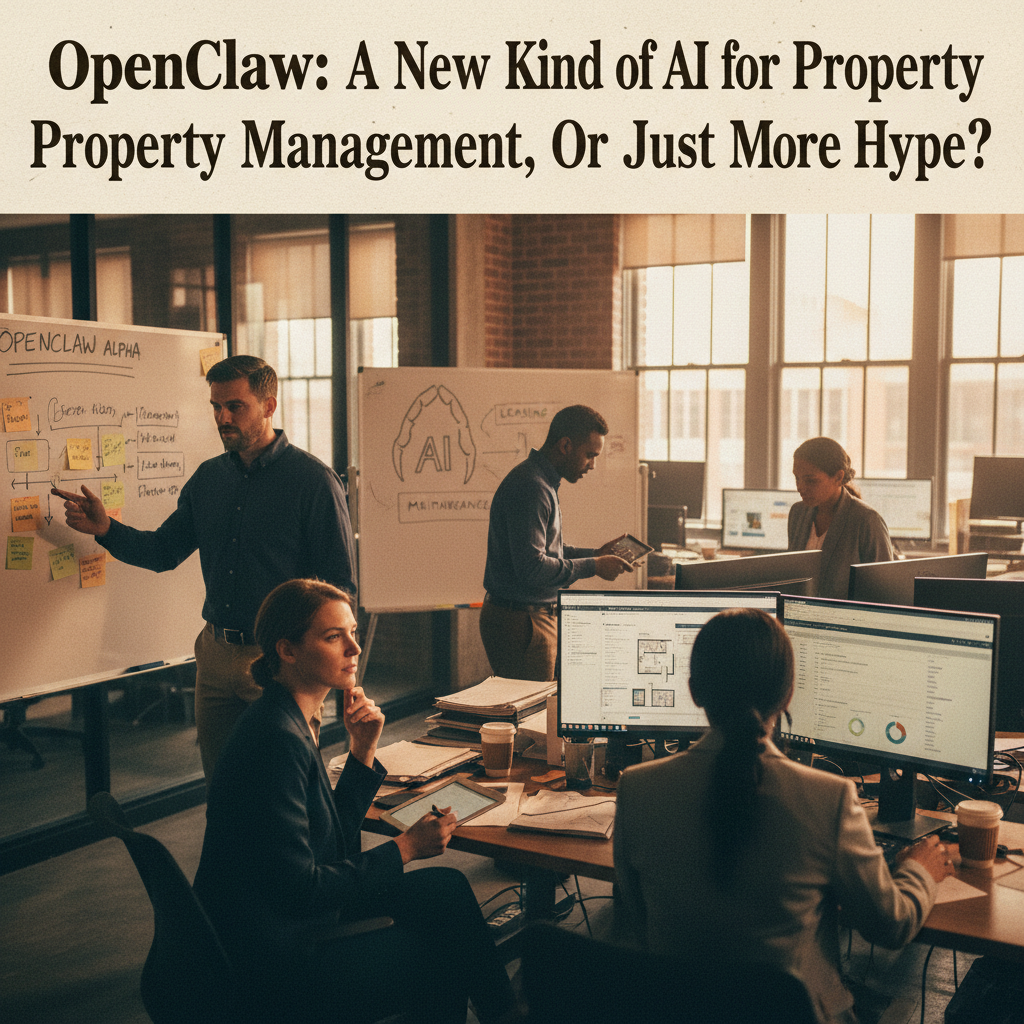
Article title: "OpenClaw: A New Kind of AI for Property Management, Or Just More Hype?" Excerpt: "OpenClaw, an open-source large language model fine-tuned for property management, offers a new paradigm for AI in our industry. Its community-driven development promises nuanced solutions for maintenance, compliance, and tenant communications. While not a magic wand, its potential to empower teams and enhance human-centered service is significant."
Content: I remember the early days of property management software, back when a 'revolution' meant moving from ledger books to a clunky desktop program that still required you to print checks and mail them. We've come a long way, haven't we? Now, every other week, it seems there's a new AI promising to change everything. And honestly, a lot of it feels like the same old song, just with fancier buzzwords. But then something like OpenClaw comes along, and it makes me pause, tilt my head a bit, and think, 'Hmm, this might actually be different.'
OpenClaw, for those who haven't stumbled upon it in a late-night scroll through Reddit discussions on property management challenges or a particularly enthusiastic industry webinar, is an open-source large language model, specifically fine-tuned for property management operations. It's not a standalone software, mind you. Think of it more as a highly specialized brain that you can plug into your existing systems. And that, my friends, is where the 'revolution' part starts to feel a little less like marketing fluff and a lot more like a genuine shift.
The Promise of Open-Source Specialization
Most of the AI tools we've seen in property management are proprietary. They're built by a company, integrated into their platform, and you use it as they've designed it. This is fine, mostly, but it often means you're stuck with their interpretation of 'efficient' or 'helpful.' What OpenClaw offers, by being open-source, is a level of transparency and adaptability that's frankly unprecedented in our sector. It means the community, us, can inspect its code, understand how it makes decisions, and, crucially, contribute to its development. Imagine a world where the collective wisdom of thousands of property managers, not just a handful of developers, shapes the intelligence assisting us daily. It's a powerful idea.
I've seen so many times where a new feature rolls out in a major PMS, and it's almost there, but it misses that one crucial nuance that only someone who's dealt with a tenant complaining about a dripping faucet at 2 AM would understand. With OpenClaw, the potential for that nuance to be baked in, through community contributions and specialized training, is immense. It's like having a shared brain that learns from everyone's best practices, not just a single vendor's vision. The OpenClaw project page on Hugging Face details their initial training data, which includes anonymized maintenance logs, lease agreements, and tenant communications. This is a far cry from general-purpose models that might struggle with the specific jargon and context of our industry.
Beyond the Hype: Practical Applications I'm Watching
So, what does this specialized, open-source brain actually do? Well, the beauty is, it can do a lot, and it can do it in ways that are tailored to your operation, not just a generic template. Here are a few areas where I see OpenClaw making a tangible difference, based on my own observations and some of the early adopters I've spoken with:
1. The Maintenance Maestro
Ah, maintenance. The bane and blessing of our existence. OpenClaw's ability to parse and prioritize maintenance requests is genuinely impressive. It's not just about keyword spotting. It can understand context. For example, a tenant's email saying, 'My toilet is running constantly, and the water bill is going to be insane!' versus 'My toilet makes a funny noise sometimes.' A general AI might flag both as 'toilet issue.' OpenClaw, trained on countless real-world scenarios, can infer urgency, potential cost implications, and even suggest initial troubleshooting steps for the tenant, all before a human even sees it. It can then draft a work order, assign it based on vendor specializations and availability, and even pre-fill common parts needed. This isn't just saving time, it's reducing the cognitive load on our teams, letting them focus on the truly complex issues. I've heard stories in r/PropertyManagement threads where managers vent about their daily struggles about how much time is wasted on miscategorized or unclear work orders, and this could be a real game-changer.
2. Lease Agreement Deep Dive and Compliance Check
Lease agreements are dense, legally binding documents. Ensuring compliance, both from the tenant and owner side, is a never-ending task. OpenClaw can be trained on your specific state and local regulations, your company's addenda, and even individual lease nuances. Imagine asking it, 'Does this lease allow for a pet deposit, or only pet rent?' or 'What's the notice period required for a rent increase for this specific tenant, given their lease start date and state law?' It can quickly cross-reference, highlight clauses, and even flag potential compliance issues before they become headaches. This isn't just about speed, it's about reducing legal risk, which, as we all know, can be astronomical. The National Apartment Association (NAA) provides extensive legal resources that could easily be incorporated into OpenClaw's training for localized compliance checks.
3. Tenant Communication, Reimagined
This is where the 'empathetic' part of AI really shines, or fails. Generic chatbots often sound robotic and unhelpful. But OpenClaw, with its specialized training on property management communications, can draft responses that are not only informative but also appropriately toned. It can answer common questions about rent payments, move-out procedures, or amenity access, freeing up our staff from repetitive inquiries. More importantly, it can analyze incoming communications for sentiment, flagging angry or distressed tenants for immediate human intervention, rather than letting them fester in a queue. It's about enhancing the human touch, not replacing it. I've seen some of the early demos of this, and the difference in tone compared to a standard chatbot is remarkable. It actually sounds like someone who understands the situation, not just a database lookup.
The Nuance: It's Not a Magic Wand
Now, before we all jump on the OpenClaw bandwagon with unbridled enthusiasm, a word of caution. It's not a magic wand. It still requires thoughtful integration, careful oversight, and, most importantly, human judgment. Open-source means you have more control, but it also means you have more responsibility. You'll need someone on your team, or a trusted partner, who understands how to deploy and manage these kinds of models. It's not just 'install and forget.'
Furthermore, the ethical considerations around AI, especially with sensitive tenant data, are paramount. While OpenClaw itself is open-source, how you use it and what data you feed it falls squarely on your shoulders. Data privacy, bias in algorithms, and the potential for misinformation are all very real concerns that require ongoing vigilance. The National Association of Realtors (NAR) has even started publishing guidelines on AI use in real estate, highlighting the need for ethical implementation.
A Human-Centered Takeaway
Ultimately, OpenClaw represents a fascinating evolution in property management technology. It's not just another vendor pushing a closed-box solution. It's a tool that, if embraced thoughtfully, has the potential to empower our teams, reduce burnout from repetitive tasks, and allow us to focus on the truly human aspects of our job: building relationships with owners, solving complex tenant issues with empathy, and making our communities better places to live. It's about augmenting our intelligence, not replacing our hearts. And in this industry, where every day brings a new challenge and a new human story, that's a revolution I can get behind.